Inconsistent Messaging
Campaigns shift tone or emphasis quarter to quarter, creating diluted market presence.

Brand strategy becomes essential when there is no shared definition of what the brand stands for — and decisions lack a unifying point-of-view.
Campaigns shift tone or emphasis quarter to quarter, creating diluted market presence.

Priorities change frequently because decisions are driven by urgency rather than a defined point of view.

The brand competes on surface claims — features, performance, price — because it hasn’t defined a distinctive role.

Agencies generate ideas, but without a clear strategic anchor, concepts feel interchangeable or disconnected.

Decisions rely on preference or hierarchy rather than agreed-upon strategic principles.

New entrants or evolving competitors force a reconsideration of the role your brand plays in the market.

Brand strategy doesn’t produce slogans. It defines the structural choices that guide every downstream decision.
Defining the arena in which you compete and the ground you choose to claim. Determining how your brand reframes the category — so differentiation is structural, not cosmetic.
Clarifying the role your brand plays in customers’ lives and the value it uniquely delivers. Moving the brand beyond functional benefits into a clearly defined relationship.
Identifying which audiences matter most — and where relevance can be earned credibly and profitably. Creating focus, preventing dilution across too many segments or inconsistent growth efforts.
Establishing a hierarchy of ideas — from core positioning to supporting proof points — ensuring consistency across campaigns, channels, and teams. Giving creative and communications a clear structure to build from rather than reinvent each time.
Defining how products, services, or sub-brands relate to one another and to the master brand. Ensuring expansion strengthens coherence rather than fragmenting identity.
Setting the principles that guide what the brand should — and should not — build, launch, or endorse. Providing a disciplined filter for evaluating new opportunities without reactive decision-making.
We don’t develop strategy to produce language. We design it to create alignment and direction. Our approach integrates insight, collaboration, and structured synthesis — ensuring positioning becomes a shared definition that guides real decisions.
We begin by clarifying the decision behind the strategy. Leadership objectives, business constraints, competitive realities, and internal tensions are surfaced early — ensuring the work addresses the true inflection point.
Customer research, internal perspectives, market dynamics, and cultural context are synthesized into a coherent foundation. Rather than layering inputs, we interpret them together to identify the structural forces shaping the brand’s opportunity.
Through structured working sessions and facilitated workshops, we engage leadership in developing potential strategic directions. This stage is disciplined and guided — designed to surface perspective, test assumptions, and build ownership without devolving into unfocused brainstorming.
Inputs from research and collaboration are distilled into a coherent strategic definition. Positioning, role, audience priority, and guardrails are clarified and refined until the direction is defensible, differentiated, and durable.
Strategy, in our view, begins with narrative psychology — the recognition that people make sense of themselves and the world through story. They choose brands not only for functional benefit, but for how those brands reinforce identity, resolve tension, and help them author a preferred future.
This is the foundation of what we describe as the narrative economy in Start with the Story. Markets are not simply exchanges of value; they are exchanges of meaning. Brands compete not only on features or price, but on the roles they are allowed to play within customers’ personal narratives.
Effective brand strategy therefore requires more than competitive analysis. It requires understanding the story customers are attempting to tell — the tensions they are navigating, the aspirations they hold, and the identities they seek to express.
From there, strategy becomes a disciplined act of definition:
What role can the brand credibly claim in that story?
What relationship should it build?
What future does it help make possible?
When a brand aligns its positioning with the narrative structures shaping customer identity, differentiation becomes durable. Engagement becomes relational. Growth becomes coherent rather than reactive.
Our outputs are designed to define positioning, clarify role, and create alignment — not simply generate language.
A structured narrative defining the customer’s struggle, the role the brand plays, the tangible reward it delivers, and the future it seeks to create. This framework anchors positioning in relationship — ensuring strategy reflects the story customers are already trying to live.
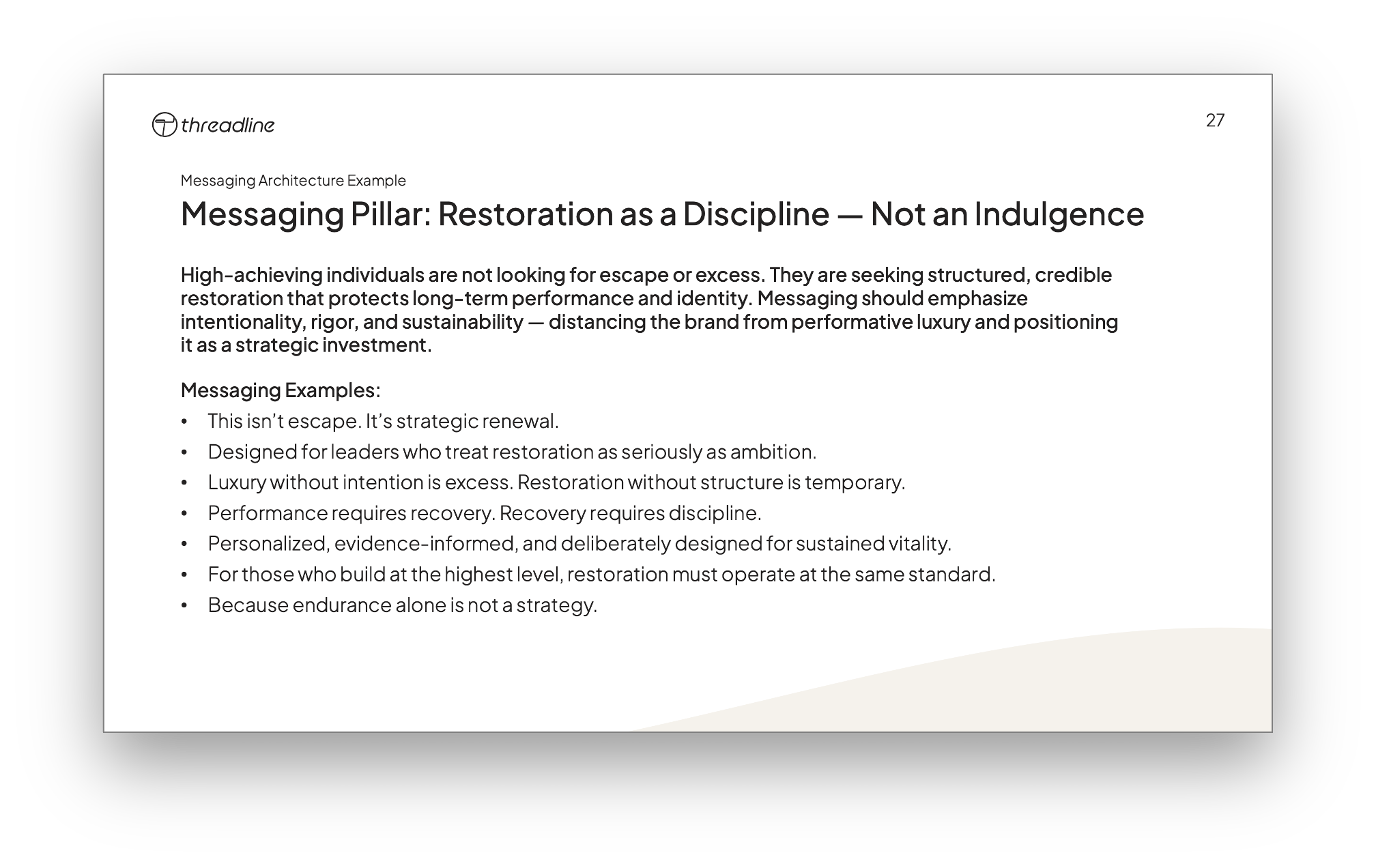
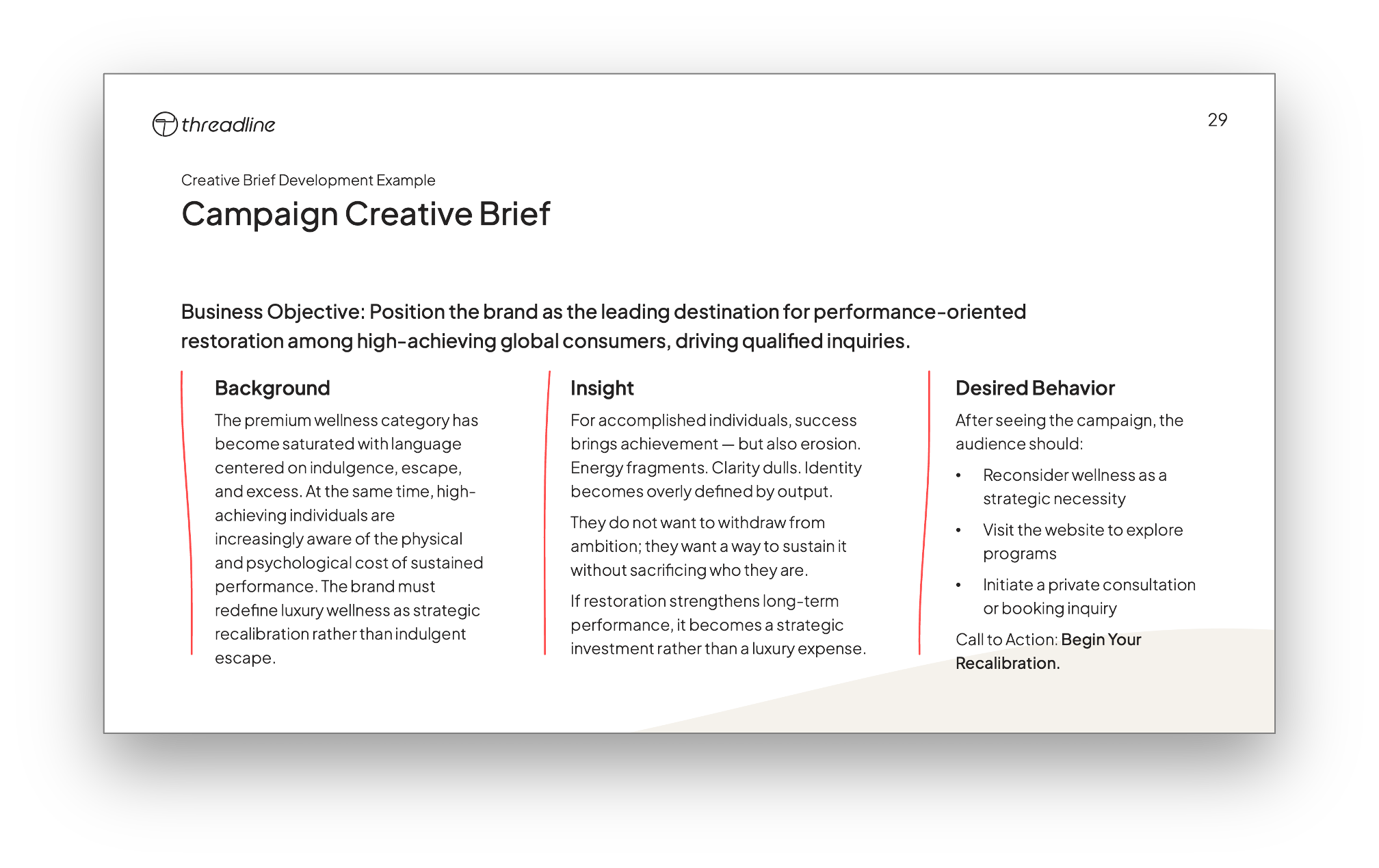
An anonymized example illustrating how positioning, narrative, messaging, and creative direction are translated into usable strategic frameworks.
Beyond definition, these tools ensure strategy informs how the brand speaks, who it prioritizes, and how ideas are brought to life.
Clarifies who the brand is for — and where strategic focus should be concentrated to build meaningful, profitable relationships.
Establishes a structured hierarchy of core messages and supporting proof points to ensure clarity and consistency across channels and teams.
Translates strategy into actionable guidance for creative execution — defining objective, insight, promise, tone, and desired behavior.
Rather than redefining direction, this engagement refined it. Through psycho-biographical research grounded in narrative psychology, we clarified how the brand authentically mirrors its drivers — strengthening creative alignment in a mature, competitive category.
Brand strategy is most valuable when the organization is facing a moment of definition — not just execution.
Organizations redefining their competitive frame, audience focus, or value proposition — and needing a clear, defensible role in the market.
Teams considering visual or messaging change who recognize that identity should follow strategy — not substitute for it.
Brands expanding into new spaces where clarity of role and narrative will determine relevance and differentiation.
Executive groups who need a shared definition of what the brand stands for — to guide messaging, innovation, and investment decisions.
If you’re facing a moment that requires sharper definition and stronger alignment, we’d welcome a conversation about your brand’s direction.