Stalled Growth
Revenue has plateaued, and leadership can’t align on what’s actually holding the brand back.

Research becomes essential when the cost of guessing exceeds the cost of understanding.
Revenue has plateaued, and leadership can’t align on what’s actually holding the brand back.

Your messaging is refined and consistent — but it’s not moving behavior.

Different teams are operating with different definitions of who the customer is and what they care about.

You’re entering a new segment or market where assumptions feel too expensive to get wrong.

Customers are leaving, and surface-level metrics aren’t explaining why.

Product, marketing, and leadership aren’t aligned on what truly matters to the customer.

The value of research isn’t in the findings. It’s in the decisions those findings reshape.
Clarifying the role your brand can credibly play in the customer’s life. Identifying which tensions, aspirations, and identity dynamics your positioning should resolve.
Revealing which customer segments offer the greatest strategic opportunity — based not just on size, but on psychological alignment. Helping teams focus investment on the audiences whose stories the brand can meaningfully enter.
Determining which themes, language, and emotional cues resonate most deeply. Ensuring communication reflects how customers already make sense of the category rather than imposing a manufactured narrative.
Identifying how products, services, and touchpoints can better support customer goals and lived realities. Translating insight into experience decisions that feel intuitive, coherent, and relationship-building.
Surfacing the psychological, contextual, and identity-based barriers that slow decision-making. Clarifying what must be resolved for customers to move forward with confidence.
Understanding how trust, relevance, and emotional connection evolve over time. Designing engagement strategies that strengthen relationships rather than relying on short-term activation tactics.
We don’t conduct research to generate interesting findings. We design it to inform real decisions. Our approach combines narrative psychology, behavioral science, and strategic rigor to ensure insights translate into direction — not just documentation.
We begin by clarifying the decisions this research must inform. Objectives, hypotheses, and success criteria are defined upfront — ensuring alignment before a single interview is conducted.
We design a methodology tailored to the strategic question — integrating qualitative, quantitative, and contextual inputs where necessary.
Through in-depth narrative interviews, surveys, or behavioral analysis, we gather data that surfaces not just what customers say — but how they make meaning.
We analyze across stories and data sources to identify recurring themes, tensions, and identity drivers — separating signal from noise.
We select methods based on the decision at hand — not the other way around.
In-depth, one-on-one conversations grounded in narrative and psychobiographical techniques. We explore lived experience, emotional drivers, and the deeper psychological patterns shaping behavior.
Structured exploration of creative ideas to understand resonance, motivation, and perceived relevance. We assess not just reaction — but why a concept connects or falls flat.
Asynchronous digital exercises using text, photo, and video responses to capture nuance over time. Journaling allows participants to reflect in context and surface details that may not emerge in interviews.
Focused evaluation of strategic messaging, language, and positioning statements. We examine clarity, credibility, emotional impact, and motivational strength at the level of word choice and framing.
In-home, on-site, or in-situation conversations conducted within the participant’s real-world environment. Observing context reveals environmental cues, artifacts, and routines that shape decision-making.
Small-group discussions designed to surface shared themes, reactions, and directional feedback. While less deep than interviews, they allow for breadth, comparison, and dynamic exchange.
Short-term online communities where participants engage in iterative exercises and respond to one another. Interaction often surfaces new insights as ideas build, evolve, and spark additional reflection.
Facilitated ideation sessions focused on generating and refining solutions. These collaborative environments help translate insight into tangible opportunities for innovation and design.
Our deliverables are built to clarify patterns, articulate implications, and guide confident decisions — not simply report findings.
A decision-oriented synthesis clarifying the patterns that matter most — and what leadership should do next. Concise, prioritized, and designed for executive alignment.
An anonymized example illustrating how insight becomes structured direction.
A full narrative analysis including participant stories, psychological patterns, tensions, and strategic implications.

Complete methodological materials including guides, recordings, transcripts, and recruitment documentation.

A working session translating findings into shared understanding, cross-functional clarity, and defined next steps.
Certain engagements extend beyond analysis into durable frameworks that guide teams long after the research concludes.
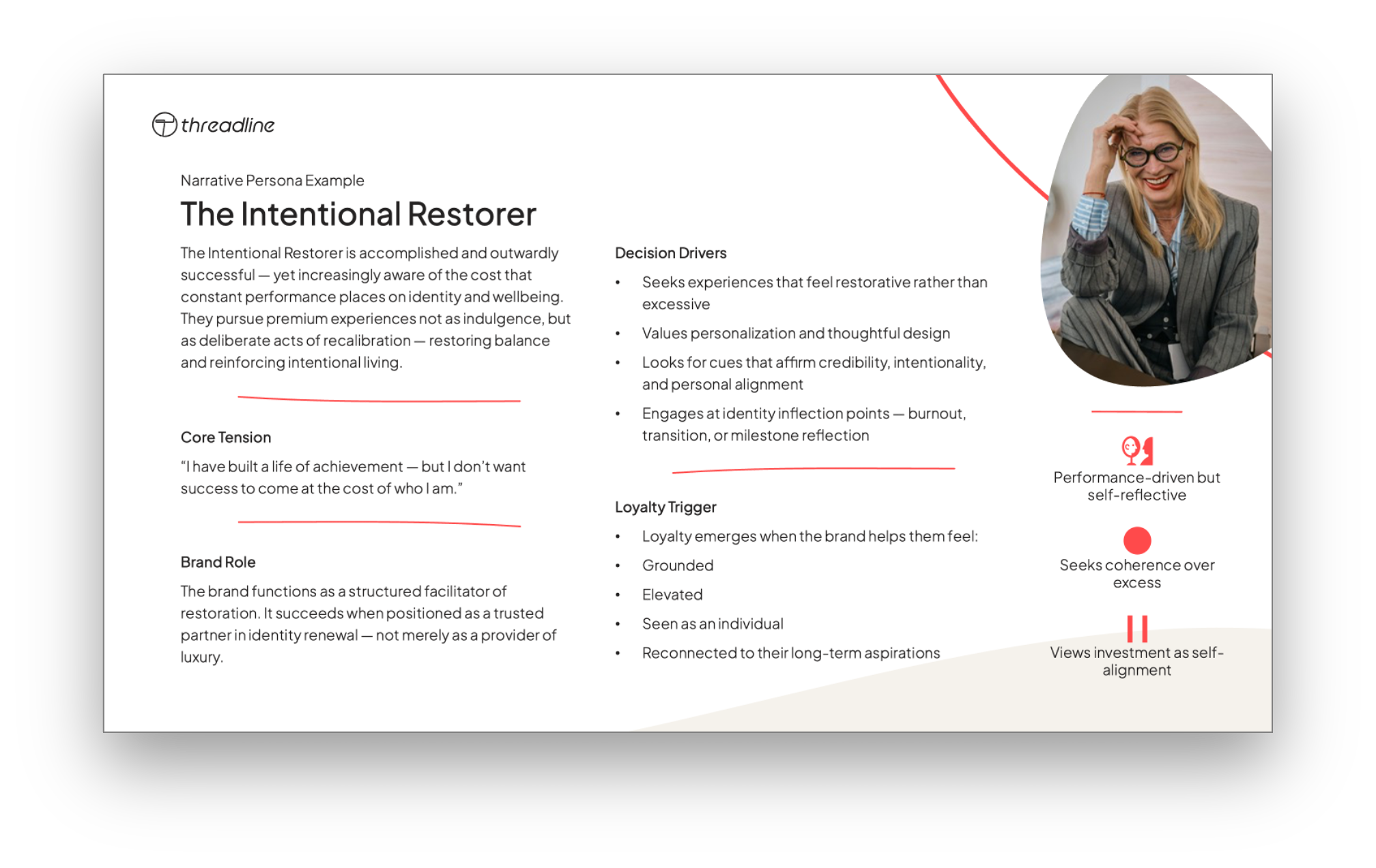
Research-grounded audience archetypes built around identity, motivation, and behavioral patterns — aligning teams around who the customer truly is.
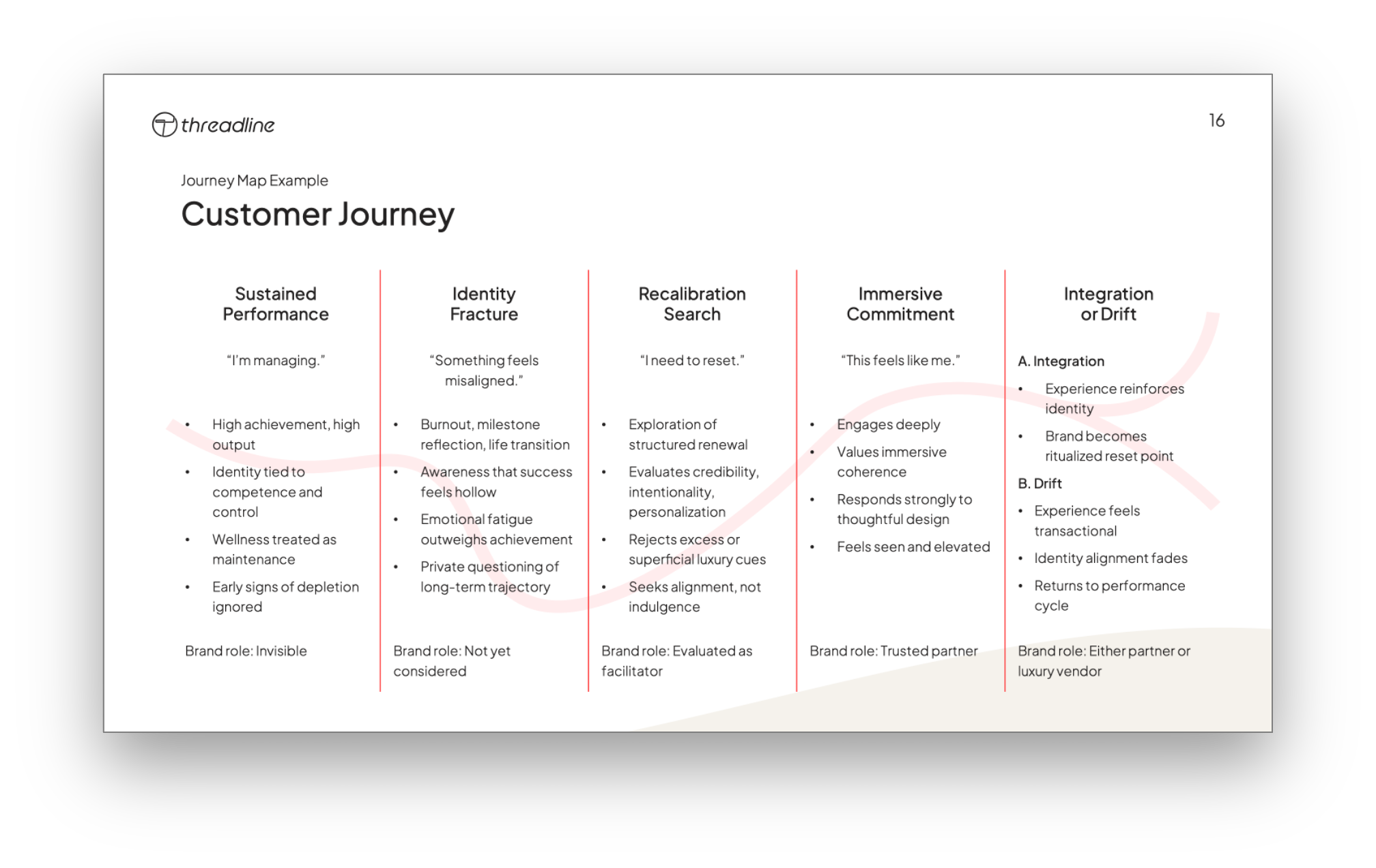
Narrative mapping of decision pathways, emotional inflection points, and friction across the relationship lifecycle.
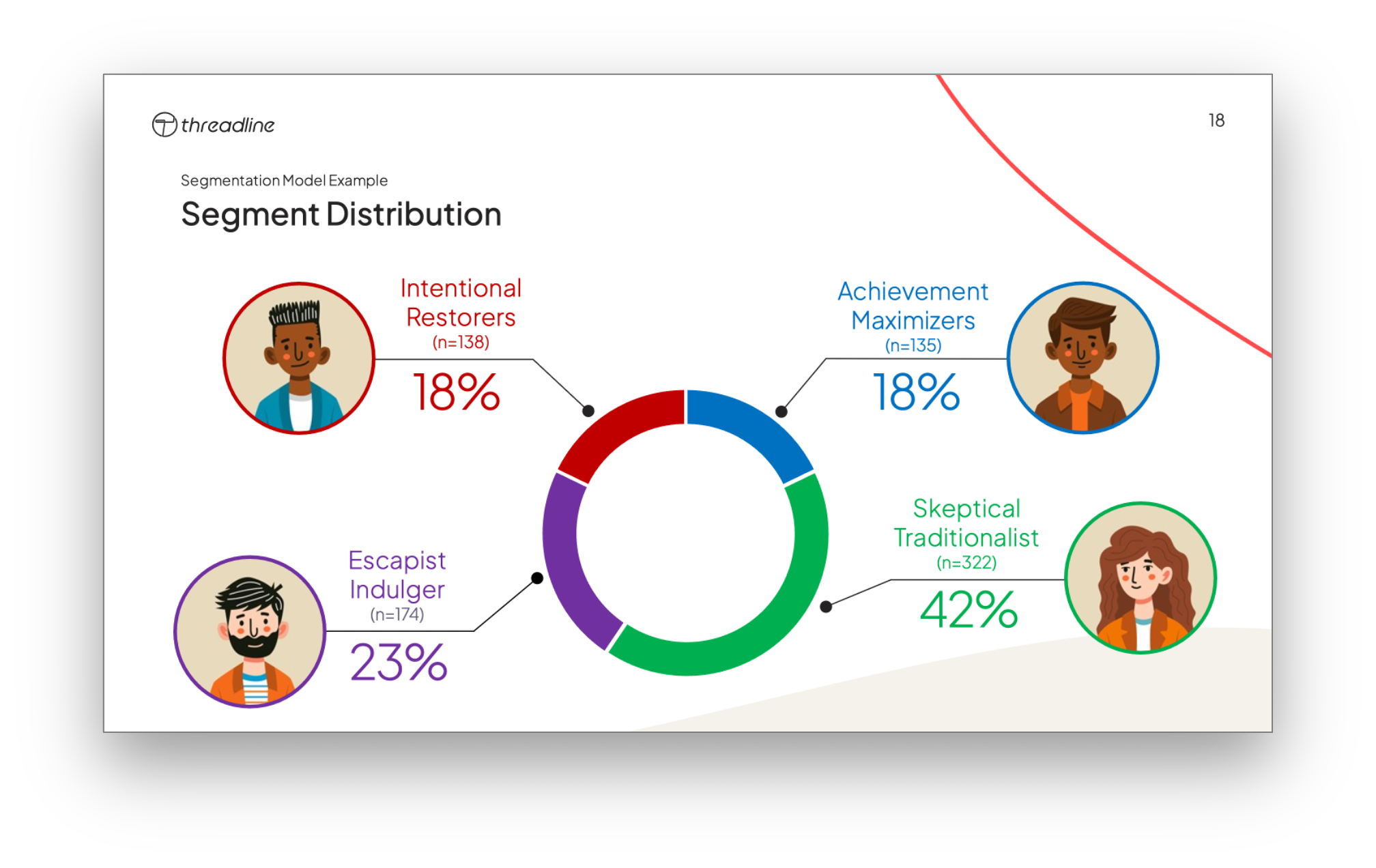
Psychologically informed segmentation models clarifying distinct audience clusters beyond demographics.
In a fast-growing but crowded plant-based milk market, a national brand needed more than interest metrics. Our narrative research revealed how adoption unfolds across specific consumption moments — enabling a repositioning that drove sustained behavior, not just trial.
We’re most effective when the work carries strategic weight and leadership alignment matters.
Organizations navigating inflection points — repositioning, entering new markets, or aligning around growth strategy.
Executive teams wrestling with ambiguous or high-impact questions where clarity, not speed, will shape the outcome.
Organizations that care about building durable trust with customers — not just short-term performance metrics.
Marketing, product, and leadership groups that need a shared understanding of the customer before moving forward.
If you’re navigating a complex decision and want research designed to shape direction — we’d welcome a conversation.